
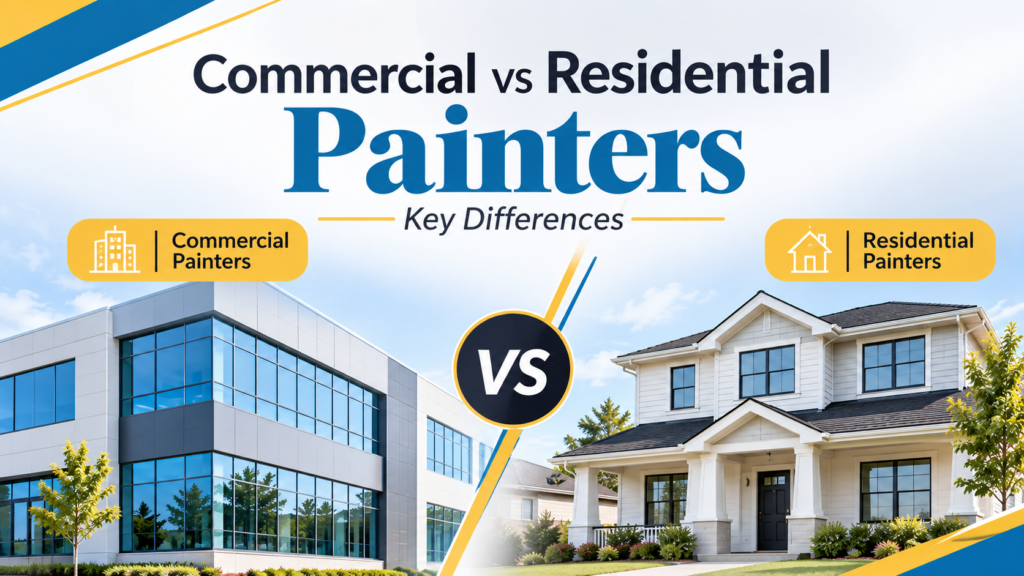
Commercial vs Residential Painters: Key Differences
Description
Commercial painters work on larger, busier properties, usually after hours, with industrial coatings, higher insurance limits and formal bids. Residential painters work in occupied homes during the day, focus on finish quality and color, and price by room or flat quote. It’s the same trade, but the planning, equipment and paperwork are different.
If you manage a restaurant, an office suite, a rental building or your own house, hiring the wrong kind of crew costs time and money. Here’s how the two differ, what each costs, and how to tell which one you need.
What Is the Main Difference Between Commercial and Residential Painters?
Residential painters work around families. They move and cover furniture, plan around pets and home offices, and spend a lot of time on trim, color and clean lines. The job is personal, and the homeowner is usually on site.
Commercial painting contractors work around operations. Their clients are businesses that can’t lose customers, so the work centers on scale, deadlines, safety and schedule. The skill overlap is real, since a good residential house painter can cut a sharp line. The difference is project management: crews, equipment and a plan that keeps a building running while it’s painted.
How Do Residential and Commercial Painting Compare Side by Side?
| Factor | Residential painters | Commercial painting contractors |
| Project scale | Single rooms to whole homes | Offices, retail, restaurants, warehouses, multi-unit buildings |
| Work hours | Weekdays, daytime | After hours, nights, weekends or in phases |
| Typical timeline | Days to about two weeks | Weeks to months on large sites |
| Surfaces | Drywall, plaster, wood, stucco | Concrete, metal, tile, block, drywall |
| Coatings | Decorative interior paint, protective exterior | Epoxy, anti-graffiti, fire-rated, industrial enamels |
| Pricing method | By room, square foot or flat quote | Per square foot or formal competitive bid |
| Paperwork | Estimate and contract | Bids, specs, insurance certificates, sometimes safety plans |
| Decision-maker | Homeowner | Owner, property manager or facilities team |
How Do Schedules Differ Between Commercial and Residential Painting?
Residential work usually runs weekdays for about eight hours a day, and homeowners can ask for weekend work if they want it done faster. Crews adjust for school drop-offs, pets and people working from home.
Commercial schedules are built around the business. Work often happens after hours, on weekends or in phases so the space stays open, and many sites have strict return-to-service deadlines. Commercial coatings often cure faster to reduce downtime. A restaurant that repaints its dining room overnight can serve lunch the next day, which is the whole point.
Do Commercial Painters Use Different Paint and Coatings?
Often, yes. Residential jobs mostly use decorative interior paints and protective exterior coatings. Commercial jobs can call for epoxy floors, anti-graffiti finishes, fire-rated products and industrial enamels, depending on the building and its code requirements.
Commercial contractors also take on services most residential crews don’t, such as sandblasting, metalizing, masonry coating and roof coatings. Surfaces differ too: commercial sites include concrete, metal and tile alongside drywall. If your property needs a specified coating, ask the contractor to name the product and explain why it fits.
Is Commercial Painting More Expensive Than Residential Painting?
Per square foot, the ranges overlap. Commercial painting averages about $2 to $6 per paintable square foot, which puts a 2,500 square foot job at roughly $5,000 to $15,000. Residential interior painting runs about $2 to $6 per square foot and exterior $1.50 to $4.
Total cost differs because of what’s in the bid. Lifts or scaffolding for buildings taller than 15 feet can add $500 to $1,500 or more per day, and specialty coatings like epoxy or anti-graffiti run higher per square foot than standard paint. After-hours labor and phased work add planning costs too. Larger sites sometimes get a lower per-square-foot rate because of volume, but the total is still bigger.
Because pricing methods differ, compare itemized bids rather than single numbers. Residential quotes usually come per room or as one flat price, while commercial bids spell out areas, coatings, coats and schedule.
What Licenses and Insurance Should Each Type of Painter Have in California?
Both types need the same state license. California requires a C-33 Painting and Decorating license from the Contractors State License Board for painting work valued at $500 or more, along with a contractor bond. That means a license alone doesn’t prove commercial experience, so look further.
Commercial clients usually ask to be named as an additional insured on the contractor’s policy, and they expect proof of workers’ compensation and compliance with safety rules such as OSHA. Residential clients should still ask for liability and workers’ comp coverage. Request a certificate of insurance from any painting company, whatever the job size.
What Happens When a Residential Painter Takes a Commercial Job?
It can go wrong in predictable ways. A home-focused crew may underestimate scope, lack the right equipment, hit scheduling conflicts with business hours, or carry insurance that doesn’t match the contract. They may also be unfamiliar with project specifications.
The reverse mismatch exists too. A crew built for large commercial sites may not be set up for color consultation, furniture protection or daily coordination with a household. Properties in the middle, like rental buildings, need a mix: quick turnovers and tough finishes with homeowner-level care. Our rental property painting service is built for that overlap.
How Do You Choose Between Commercial and Residential Painting Companies?
Match the crew to the property, then ask these questions:
- Have you painted properties like mine? Ask for photos and references of the same type.
- How will you schedule around my operations or household?
- Can you send a certificate of insurance, and add me as additional insured?
- Which coatings will you use, and what does the manufacturer warranty cover?
- Do your own employees do the work, or subcontractors?
At Hire A Painter, we handle both. Our commercial painting services include night and weekend scheduling so businesses don’t lose sales days, and we hold CSLB license 1121520 with in-house crews and a 5-year warranty. See examples for restaurant painting and office building painting, or look at our project gallery for finished jobs. Compare the same details across every painting company you talk to, including us.
Frequently Asked Questions
Q: What is the difference between commercial and residential painting?
Commercial painting covers larger business properties, often after hours, using industrial coatings and formal bids. Residential painting covers homes during daytime hours, with decorative paints, color choices and price by room or flat quote. The skills overlap, but planning, insurance and equipment differ.
Q: Is commercial painting more expensive than residential painting?
Per square foot the ranges are similar, around $2 to $6 for both. Commercial total costs run higher because buildings are larger and may need lifts, specialty coatings and after-hours labor. Always compare itemized bids.
Q: Can a residential painter do commercial work?
In California both need a C-33 license, so a residential painter can be licensed for commercial jobs. The gap is experience: scheduling around a business, insurance limits, specifications and equipment. Ask for commercial references before hiring.
Q: How long does a commercial painting project take?
It depends on size. A small office suite can take a few days, while large buildings run weeks or months, often in phases. Residential projects usually take days to about two weeks.
Q: Do commercial painters work at night or on weekends?
Often. After-hours and weekend work keeps customers and staff from being disrupted. Confirm the schedule in writing, including who is on site, how the space is secured and when it reopens.
Q: How do I choose a commercial painting company?
Verify the C-33 license, request proof of insurance and additional insured status, and ask for references on similar properties. Compare written bids on prep, coatings, coats, schedule and warranty, not just price.
Ready to compare bids? Call (858) 388-0036 or request a free estimate.